In This Article
Picture the British summer ritual. You fill the paddling pool on the one sunny Saturday, the kids shriek with joy, and by Tuesday the water looks like pea soup with ambitions. Leaves, grass clippings, sun cream and the odd mystery insect all end up in there. A cartridge filter pump is the cheapest way to stop that slide, and it saves you from tipping out hundreds of litres of water every few days.
The catch is that the market is crowded with near-identical grey-and-blue boxes. Some are built for a pool the size of a bathtub and some for a 4.5 m frame pool. The numbers on the box (gallons per hour, litres per hour, “system flow”) are confusing, and picking the wrong cartridge filter pump means cloudy water or a pump that strains.
I’ve compared seven real, widely sold models using published specifications, maker guidance and retailer data. I’ve also added the sizing maths the listings leave out. Water safety matters too. RoSPA’s garden water safety advice is worth a read before any pool goes up, because small children can drown in very little water.
Quick Comparison Table: Cartridge Filter Pump Options at a Glance
| Pump | Rated flow (l/h) | Maker’s pool range | Cartridge | Best For |
|---|---|---|---|---|
| Bestway Flowclear 330 gal (58381) | 1,249 | 1,100–8,300 L | Check manual | Tiny paddling pools |
| Intex Krystal Clear 26602 | 1,250 | Small to medium | Type H | Compact, space-limited setups |
| Intex C530 (26604) | 2,006 | Small pools | Type A | Easy-to-find spare cartridges |
| Bestway Flowclear 800 gal | 3,028 | 1,100–17,400 L | Size II | Best headroom per pound |
| Outsunny 800 GPH | 3,028 | 4–4.5 m pools | Pleated, own size | Budget frame pools |
| Intex C1000 with Gauge (26638) | 3,785 | Up to 16,805 L | Type A | Taking the guesswork out of cleaning |
| Intex 28636 with Timer | 5,678 | Medium to large | Type A | Set-and-forget schedules |
The headline flow rate is only half the story. The Bestway Flowclear 800 gal and the Outsunny 800 GPH share the same 3,028 l/h rating, but their pool-size guidance and power draw differ. If you only have a small inflatable, the Bestway Flowclear 330 gal (58381) is the sensible choice. If your pool is larger and your weekdays are busy, the Intex 28636 with Timer earns its higher price.
💬 Just one click — help others make better buying decisions too!😊
What Is a Cartridge Filter Pump?
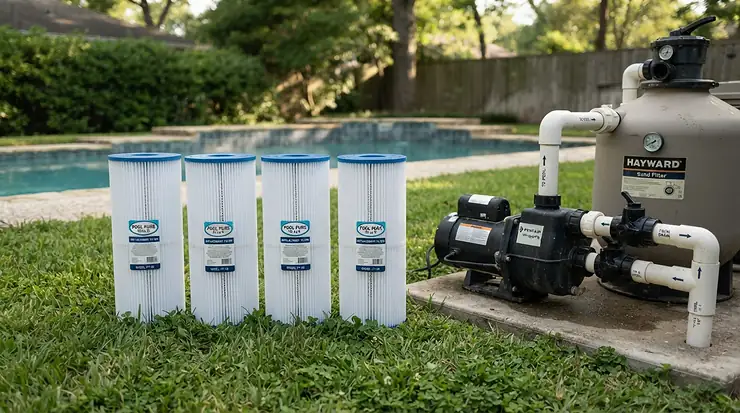
A cartridge filter pump is an all-in-one unit that pulls pool water through a pleated paper or polyester cartridge, which traps leaves, grass, sun cream residue and fine debris. The cleaner water then returns to the pool. It connects with two hoses and a plug, and it needs no sand and no backwashing.
That simplicity is the appeal. Unlike a sand system, you never touch a multi-way valve. You lift the lid, pull out the cartridge, rinse it with a hose and drop it back in. Manufacturers pitch these units at small and medium above-ground pools, and for good reason. The cartridge catches finer particles than a basic skimmer net, and the pump keeps the water moving so it stays fresher for longer.
A cartridge filter pump does not sanitise water. It filters out physical debris, but it does not kill bacteria or replace chlorine or another approved sanitiser. Think of it as the bouncer at the door who removes the rowdy leaves, not the cleaner who disinfects the floor.
Top 7 Cartridge Filter Pump Picks: Expert Analysis
1. Bestway Flowclear 330 gal (58381) — gentle, compact power for tiny pools
This is the smallest pump in the Bestway range, built for pools that would otherwise rely on a net and good intentions.
Bestway’s published figures give 1,249 litres per hour of pump capacity but only 1,060 l/h at “system” level. That gap is the resistance from the hoses and cartridge. The maker’s range is 1,100–8,300 litres. In practice, treat the top of that range with caution, because 8,000 litres at 1,060 l/h means one full turnover takes nearly eight hours.
Based on the spec comparison, the sweet spot is a pool of roughly 1,500–4,000 litres, where the pump can complete several turnovers in a working day. At around 2.85 kg it is also easy to carry and tuck behind a pool, and the listing notes a UK plug.
On reviews, I could not verify a large enough pool of independent feedback for this exact model, so I won’t summarise sentiment I can’t source. Check the most recent buyer comments for noise and hose-fit remarks before ordering.
Pros:
- ✅ Light and compact, easy to store
- ✅ Gentle, appropriate flow for small pools
- ✅ UK plug supplied, simple hose hookup
Cons:
- ❌ Too slow for pools above about 5,000 litres
- ❌ Check the cartridge size before buying spares
Price: UK listings at the time of research sat in the region of £25–£40, so it is good value for small paddling pools.
2. Intex Krystal Clear 26602 — smallest footprint in the Intex range
The Intex Krystal Clear 26602 is the pump to pick when the space behind your pool is a flowerbed you care about.
One retailer’s data lists a maximum flow of 1,250 l/h and an actual flow of about 1,003 l/h. That “actual” figure is the honest number to plan around. The body measures roughly 19 × 14 × 21 cm, and it uses Type H multi-fold Dacron paper cartridges, which pack more filter area into a small space than flat media.
The cost is that Type H cartridges are a different part from the Type A cartridges used by other Intex pumps. If you have a spare Type A from an older pump, it will not fit. Based on the specs, this suits small to medium pools where you want gentle circulation and run the pump for a long daily stretch.
For review sentiment, I couldn’t verify enough independent reviews for this model, so check recent buyer feedback on the listing. Retailer guidance suggests swapping the cartridge about every two weeks.
Pros:
- ✅ Very small body, easy to hide
- ✅ Multi-fold cartridge boosts debris capacity
- ✅ Sensible actual-flow figure published
Cons:
- ❌ Type H cartridges don’t fit other Intex pumps
- ❌ Too weak for larger frame pools
Price: UK and European retail listings pointed to roughly £25–£35, which is fair for a compact, branded unit.
3. Intex C530 (26604) — mid-step power with easy-to-find cartridges
If the Intex Krystal Clear 26602 is the entry rung, the Intex C530 (26604) is the one above it, with more flow and the common Type A cartridge.
The listing gives a pump flow of 2,006 litres per hour and Type A compatibility, and describes cartridge filtration as an economical option for small pools. A sibling listing for a similar 530 gal/h Intex shows system flow roughly 10% below the pump rating. Assuming the same here, expect effective flow of around 1,800 l/h.
Type A cartridges are among the most stocked pool spares in the UK, which matters in July when the shop shelf is empty and your cartridge is grey. For a pool of 3,000–6,000 litres, a pump in this class completes a turnover in roughly two to three hours. That is comfortably quick, and it leaves you flexibility to run it for a shorter day.
I couldn’t verify a meaningful set of independent reviews for this exact model, so I’m not summarising any. Look for recent comments on noise and cartridge longevity.
Pros:
- ✅ Type A cartridges are widely stocked
- ✅ Roughly double the flow of entry-level units
- ✅ Suits small to mid-size pools
Cons:
- ❌ No timer or gauge included
- ❌ System flow sits below the headline figure
Price: listings sat at around £30–£40, a strong middle-ground value.
4. Bestway Flowclear 800 gal — best headroom for the money
The Bestway Flowclear 800 gal is the pump I’d shortlist first for anyone unsure whether their pool will grow.
Specifications put pump flow at 3,028 l/h and system flow at 2,195 l/h. The maker’s range is 1,100–17,400 litres, and a Dutch retailer listing shows a 32 W motor, 32 mm hose connections and a Size II cartridge. A UK retailer lists a compatible Size II cartridge that also fits the 530 gal model. Those details are useful when you’re hunting for spares.
On paper, 2,195 l/h turns over a 6,000-litre pool in under three hours. That is plenty, and it means you can run the pump for a few hours a day instead of all day. A 32 W motor also keeps running costs low. The same listing mentions saltwater compatibility, which is unusual at this price.
I couldn’t verify enough independent reviews for this exact unit, so check recent buyer feedback. Cartridge life is quoted by the maker at a minimum of two weeks with regular pool use.
Pros:
- ✅ Generous flow with low wattage
- ✅ Wide pool-size range, so it can grow with you
- ✅ Widely listed Size II spares
Cons:
- ❌ Overkill for very small pools
- ❌ Cartridge type needs checking when buying spares
Price: around £35–£50, which is excellent value for the flow you get.
5. Outsunny 800 GPH — budget muscle for 4 m frame pools
The Outsunny 800 GPH is aimed squarely at 13–15 ft frame pools and arrives with the basics in the box.
The retailer specification lists 3,028 l/h, a 60 W rating, 220–240 V, a 2 m cable and two hoses with clamps. The pleated cartridge measures about 106 × 136 mm. The listing recommends replacing the cartridge every one to two months, which looks optimistic next to the two-week norm from other makers. UK testing site Testix measured a cartridge needing replacement after 16 days in a high-use family pool.
The 60 W motor draws nearly double the Bestway Flowclear 800 gal‘s 32 W for the same headline flow. Over a season that is pennies, but it is a reminder that cheaper is not automatically cheaper to run. It is best for people who already own a compatible Outsunny pool and want one-brand simplicity.
I couldn’t verify enough independent reviews, so check the latest buyer feedback and the cartridge’s availability.
Pros:
- ✅ Strong flow at budget pricing
- ✅ Hoses and clamps included
- ✅ CE-LVD and EMC certification listed
Cons:
- ❌ Higher wattage than rivals
- ❌ Cleaning interval looks optimistic
Price: around £40–£45 on the retailer’s listing, which is competitive.
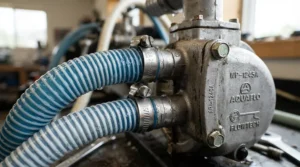
6. Intex C1000 with Cartridge Gauge (26638) — a gauge tells you when to clean
The Intex C1000 with Cartridge Gauge (26638) solves a surprisingly annoying problem, which is knowing when the cartridge is actually dirty.
Retailer data lists 3,785 l/h (1,000 US gal/h), pools up to about 16,805 litres, a UK three-pin plug and one Type A cartridge included. Double insulation and an air-release valve for trapped air are standard. The pump carries a two-year warranty and the hoses and fittings carry 180 days.
The gauge is the star. Instead of the “eyeball it” method, you read the dial and clean when it tells you to. Compared with the Intex 28638, the non-gauge sibling at the same flow, you pay a little more for the dial. For households that run the pump daily, it removes the guesswork.
I couldn’t verify enough independent reviews for this model, so I’m not summarising any.
Pros:
- ✅ Gauge shows when cleaning is due
- ✅ Two-year pump warranty
- ✅ Suits pools up to about 16,800 litres
Cons:
- ❌ Oversized for tiny pools
- ❌ Hoses and fittings only covered for 180 days
Price: roughly £60–£90, sensible value if you value the gauge.
7. Intex 28636 with Timer — set-and-forget scheduling
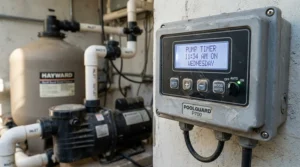
The Intex 28636 with Timer is the cartridge filter pump with timer for people who want the pool to look after itself while they’re at work.
Listings give 5,678 l/h pump flow (1,500 US gal/h) and about 1,180 gal/h (roughly 4,466 l/h) system flow. A retailer listing for this class of Intex describes preset timer cycles from 2 to 12 hours, plus an air-release valve and a sediment flush valve. Another UK-sold listing describes the timer differently, so check the product page for the exact timer specification before buying. The larger Intex 28634 is described as having a 24-hour timer and 9,463 l/h flow.
A timer is not just convenience. It lets you run the pump during daytime heat, avoid evening noise and keep a consistent daily schedule. For a pool of 6,000–15,000 litres, the system flow gives roughly two to four turnovers per eight hours.
I couldn’t verify enough independent reviews, so check the latest feedback on timer reliability.
Pros:
- ✅ Built-in timer automates daily running
- ✅ Strong flow for mid-to-large pools
- ✅ Type A cartridges are easy to find
Cons:
- ❌ Costs noticeably more than non-timer pumps
- ❌ Timer details vary between listings
Price: around £80–£110, good value if you’d otherwise forget to switch it on.
Cartridge Filter Pump for Small Paddling Pool: What Actually Fits
Here is the honest truth about a cartridge filter pump for small paddling pool use: bigger is not better. A pump that churns 3,000 l/h through a 1,500-litre inflatable creates a whirlpool of anxiety, strains the connectors and pulls the pool wall inwards.
For small pools, look for system flow of roughly 1,000–2,000 l/h. The Bestway Flowclear 330 gal (58381) and the Intex Krystal Clear 26602 both sit in this zone, and the Intex C530 (26604) is the upper end. At those flows, a 1,500-litre pool turns over in roughly 1–1.5 hours, so even a short daily run cleans the water multiple times.
Check connector compatibility before buying. Inflatable pools use different hose sizes and fittings, and adapters are not always included. Look for a unit that lists 32 mm hose compatibility or ships with adapters.
One more trap is storage. A cartridge filter pump for small paddling pool use gets packed away each autumn, so a compact body helps. If you’d rather not leave a pump running in a small pool at all, remember that emptying and drying the pool is the safest end-of-day routine for little ones.
Flow Rate in Litres per Hour: Reading the Numbers Without Getting Lost
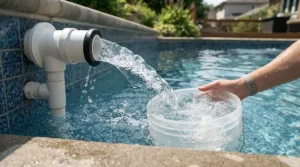
The flow rate in litres per hour is the single most-quoted spec on a pump box, and also the most misunderstood. There are two numbers you’ll see.
Pump flow is the maximum rate with no resistance, like measuring how fast a tap runs when nothing is attached. System flow is the realistic rate once hoses, fittings and a cartridge are in the way. For example, the Bestway Flowclear 800 gal lists 3,028 l/h pump flow against 2,195 l/h system flow, a loss of roughly 28%. Always plan around the system number.
Many labels quote US gallons per hour. Multiply by 3.785 to get litres, so 330 gal/h is about 1,249 l/h and 1,000 gal/h is about 3,785 l/h. Names like “330 gal” or “800 gal” are shorthand for the pump rating.
A useful sanity check is to divide pool volume by system flow. A 3,000-litre pool at 1,060 l/h takes about 2.8 hours for one full turnover. Run the pump for six hours and the water circulates roughly twice. That is a rule of thumb, not a regulation, so treat it as a guide and adjust for heavy use, hot weather and debris.
Pump-to-Pool-Size Compatibility: Matching Pump to Pool
Pump-to-pool-size compatibility is where most buying mistakes happen. A pump rated for 17,400 litres will happily filter a 3,000-litre pool, but one rated for 8,300 litres will struggle with a 15,000-litre pool no matter how long you run it.
| Pool volume | Sensible pick | Approx. turnover time | Best For |
|---|---|---|---|
| ~1,500 L | Bestway Flowclear 330 gal (58381) | ~1.4 hours | Small inflatable paddling pools |
| ~3,000 L | Intex Krystal Clear 26602 | ~3 hours | Compact family pools |
| ~6,000 L | Bestway Flowclear 800 gal | ~2.7 hours | Growing family pools |
| ~12,000 L | Intex C1000 with Cartridge Gauge (26638) | ~3.5–4 hours | Larger frame pools |
| ~15,000 L | Intex 28636 with Timer | ~3.4 hours | Big pools with busy owners |
Turnover figures use system flow where published and are estimates where only rated flow exists. The table shows that matching is about turnover time, not just whether a pump physically connects. The Bestway Flowclear 800 gal is the flexible middle, while the Intex 28636 with Timer only makes sense once the pool is big enough to justify it.
Err on the side of the next size up if your garden is shady, sheltered under trees, or used by lots of kids. Dirt loads rise fast with heavy use, and a slightly stronger pump cushions you against it.
Cartridge Filter Pump with Timer: Is It Worth the Extra?
A cartridge filter pump with timer sounds like a luxury until you’ve forgotten to switch the pump on for three days. A timer removes that failure point.
Among the pumps researched, the Intex 28636 with Timer is the obvious option, with the Intex 28634 as a larger sibling. Retailer listings for these models describe the timer differently, with some mentioning 2–12 hour presets and others describing up to 24 hours, so check the exact product page.
The cheaper alternative is an outdoor-rated plug-in timer or smart plug on any pump. Pumps in this class draw only 30–60 W, so the load is tiny. Make sure the timer suits outdoor use, sits in a dry sheltered spot and plugs into an RCD-protected socket.
A built-in timer makes sense if you value a tidy setup and fewer cables. A separate timer makes sense if you already own a pump and want flexibility, such as shorter winter runs or two sessions a day. For a basic paddling pool, a separate timer is usually the thriftier route.
How to Choose a Cartridge Filter Pump: 6 Steps
- Work out your pool volume. Use the maker’s stated capacity, not the “full to the brim” figure, since you’ll normally fill lower.
- Aim for a turnover of about 3–4 hours at system flow. This gives you flexibility to run shorter days and still keep the water fresh.
- Check the maker’s pool-size range. Choose a pump where your pool sits in the middle of the range, not at the top edge.
- Confirm the cartridge type. Type A, Type H and Size II are not interchangeable, and a rare cartridge becomes a summer headache.
- Match connectors and hose size. Check for 32 mm or 38 mm fittings and whether adapters are included.
- Decide on timer and gauge. A timer suits busy households, a gauge suits forgetful ones, and neither is essential for tiny pools.
If you follow these six steps, you’ll avoid the two classic mistakes. One is buying a pump too weak for the pool, and the other is overpaying for features you won’t use.
How Often Should I Clean the Cartridge?
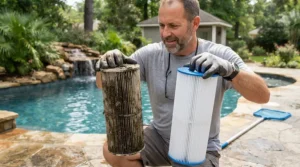
How often should I clean the cartridge? In heavy use, rinse it every one to two days and replace it roughly every two weeks, following your manufacturer’s manual. In light use, a weekly rinse and monthly replacement is more realistic.
The guidance varies, which is useful context. A retailer for the Intex 28634 suggests rinsing with water once a day and replacing every two weeks. Bestway quotes a minimum of two weeks for the Bestway Flowclear 800 gal cartridge with regular use. The Outsunny 800 GPH listing suggests one to two months. Testix reported one test cartridge needing replacement after 16 days in a high-use family pool.
Here is a practical routine:
- Daily check in hot weather: look at the cartridge and rinse if it’s visibly dirty.
- Rinse with a hose, never a pressure washer: the pleats are delicate.
- Replace when pleats are damaged, discoloured or still dirty after rinsing.
- Always unplug before opening the lid.
A dirty cartridge reduces flow, strains the motor and lets water turn cloudy. A cartridge filter pump with a gauge, like the Intex C1000 with Cartridge Gauge (26638), removes the guesswork. Hygiene still matters regardless of filtration, and gov.uk guidance on cryptosporidium advises avoiding swimming for two weeks after diarrhoea stops, because filters alone cannot protect other swimmers.
Practical Setup Guide: Your First 30 Days
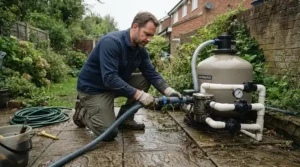
Setting up a cartridge filter pump takes about fifteen minutes, but the details decide whether it works first time.
Day one:
- Place the pump on firm, level ground close to the pool, so hoses are short and not kinked.
- Match each hose to the correct inlet and outlet, following the labels in the manual.
- Open the air-release valve until water appears, so the pump doesn’t run dry.
- Plug into an RCD-protected outdoor socket, never an extension lead left on wet grass.
First week:
- Check the cartridge every day or two and rinse as needed.
- Note how long the water takes to look clear after a hot afternoon.
Common first-month mistakes:
- Running the pump with an air lock, which causes humming and no flow.
- Forgetting the cartridge is a consumable and ordering spares too late.
- Using a pump that is far too big for a small inflatable.
- Leaving the pump running in rain with exposed connections.
By week four you’ll know your pool’s rhythm. Adjust run times with a timer or a plug-in schedule, and keep a spare cartridge on hand so cleaning day never means waiting for a delivery.
Real-World Scenarios: Which Pump Matches Which Household?
Scenario 1: The weekend family with a small inflatable. Budget is tight, the pool holds around 1,500 litres, and the pump will run for a few hours on sunny days. The Bestway Flowclear 330 gal (58381) or the Intex Krystal Clear 26602 fits perfectly. Either completes a turnover in under two hours, and neither dominates the garden.
Scenario 2: The working parents with a 12 ft pool. The pool holds roughly 6,000 litres, and nobody’s home to switch the pump on. The Intex 28636 with Timer keeps a schedule automatically. A cheaper route is the Bestway Flowclear 800 gal plus an outdoor-rated plug-in timer, which delivers a similar result for less.
Scenario 3: The frame-pool owner watching costs. A 4 m frame pool holds several thousand litres, and the owner wants decent flow without a big outlay. The Outsunny 800 GPH suits a 13–15 ft Outsunny pool, though the Bestway Flowclear 800 gal wins on lower power draw. Pair either with a spare cartridge and a clear cleaning routine.
These examples show a common thread. The best cartridge filter pump is the one sized to your pool and your habits, not the one with the biggest number on the box.
Cartridge Filter Pump vs Sand Filter Pump: Which Is Better?
Cartridge and sand systems solve the same problem in different ways, and each has trade-offs.
| Option | Maintenance | Upfront cost | Best For |
|---|---|---|---|
| Cartridge filter pump | Rinse or replace cartridges | Low | Small to mid-size pools, simplicity |
| Cartridge filter pump with timer | As above, plus automated running | Low to mid | Busy households |
| Sand filter pump (e.g. Hydro-Fit FSU-8TP) | Backwash, change sand every 3–5 years | Higher | Bigger pools, long seasons |
A Hydro-Fit sand filter combo with a timer was listed at around £200–£250, with a six-function valve, a strainer basket and a 17 kg sand capacity. The Intex 2100 GPH Sand Filter Pump is marketed with a built-in timer and little maintenance beyond occasional sand replacement. Both need more space and more setup knowledge than a cartridge model.
For a paddling pool or a small frame pool, a cartridge filter pump is usually the more sensible choice, because there is no backwash valve to learn and no sand to shift. Sand starts to make sense for bigger pools in daily use, where running costs and cartridge consumption add up.
Long-Term Cost & Maintenance: What You’ll Really Spend
The pump price is only the opening line. The real spend is cartridges and electricity.
Cartridges are cheap but regular. Listings for compatible Size II cartridges and Bestway Flowclear cartridge two-packs sat in the under-£10 range. If you replace every two weeks across a 12-week summer, that’s six cartridges, so budget roughly £30–£55 per season.
Electricity is small. A 32 W pump running eight hours uses about 0.26 kWh a day, and a 60 W pump about 0.48 kWh. Assuming roughly 25p per kWh (check your own tariff), that’s about 6p–12p per day.
| Pump | Pump price range | Est. daily running cost | Best For |
|---|---|---|---|
| Bestway Flowclear 330 gal (58381) | £25–£40 | Low | Smallest pools |
| Bestway Flowclear 800 gal | £35–£50 | ~6p | Value and headroom |
| Outsunny 800 GPH | £40–£45 | ~12p | One-brand Outsunny setups |
| Intex 28636 with Timer | £80–£110 | Low to moderate | Automation |
The cheapest pump isn’t always the cheapest to own. The Outsunny 800 GPH costs a little more to run than the Bestway Flowclear 800 gal for similar flow, while the Intex 28636 with Timer pays back in convenience rather than pennies.
Safety, Regulations and Compliance: Water and Electricity Don’t Mix
Any mains-powered pump near water deserves respect. Use an RCD, keep connections dry and be sensible about when the pump runs.
The RHS guide to electricity in the garden recommends RCD protection for plug-in devices, advises against using electrical equipment in the rain and says to use a qualified electrician when installing new sockets. If your outdoor socket has no built-in RCD, a plug-in RCD adaptor is a minimum precaution.
Look for CE or UKCA markings and a UK plug. The listings reviewed mention CE approval, a UK plug and certifications such as LVD and EMC. Many manufacturers’ manuals advise switching off and unplugging the pump when people are in the water, so check yours.
The bigger risk with paddling pools is not electrical. Even shallow water is dangerous for small children, so supervise closely, empty the pool after use and keep the pump cable out of reach.
FAQ
❓ How long should I run a cartridge filter pump each day?
❓ Do I still need chlorine with a cartridge filter pump?
❓ Why is my cartridge filter pump humming but not circulating water?
❓ Can I leave my cartridge filter pump out in the rain?
❓ Will a cartridge filter pump fit a different brand of pool?
Conclusion
Choosing a cartridge filter pump doesn’t have to be a maths exam. Match the system flow to your pool volume, check the cartridge type, decide whether a timer or gauge earns its place, and set up a simple cleaning routine. Do those four things and the pool stays clearer for longer.
For a small paddling pool, the Bestway Flowclear 330 gal (58381) and the Intex Krystal Clear 26602 are sensible, low-fuss choices, with the Intex C530 (26604) a notch up. For flexible value across growing pools, the Bestway Flowclear 800 gal is hard to beat. If you want a gauge or a timer, the Intex C1000 with Cartridge Gauge (26638) and the Intex 28636 with Timer are the convenience picks.
Remember that no filter replaces supervision, hygiene and safe electrics. Use an RCD, empty small pools after use and keep a spare cartridge in the shed.
✨ Ready to keep your pool sparkling all summer? 🏊♂️ Click any highlighted product name above to check current pricing and availability on Amazon UK, and give your garden the clear, inviting water it deserves! 💦
Recommended for You
- Family Pool Complete Set With Accessories: 7 Smart Buys (2026)
- Pool Cover And Ladder Sets: 7 Best Picks For UK Gardens (2026)
- Pool Cover And Ladder Set: 7 Best, Safest Picks (2026)
Disclaimer: This article contains affiliate links. As an Amazon Associate, I earn from qualifying purchases. If you purchase products through these links, we may earn a small commission at no additional cost to you.
✨ Found this helpful? Share it with your friends! 💬🤗
