In This Article
Somewhere between “I really should exercise more” and “I really don’t want to drive to a leisure centre at 6am” sits a very British compromise: swim current pools. You step in, flick a dial, and a wall of moving water arrives to argue with your front crawl. You go nowhere. You still get somewhere.
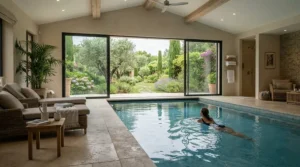
A swim current pool is essentially a compact pool or spa that uses a pump, jet, or propeller to generate a continuous flow of water, letting you swim, jog, or do resistance training on the spot rather than needing pool-length space. It is the garden-sized answer to a 25-metre lane you will probably never get to install. For a country with a housing stock built long before anyone imagined a residential lap pool, that matters enormously.
We have spent this guide digging into seven real machines currently sold in the UK, from Surrey-based Canadian Spa Company models stocked by B&Q to the propeller-driven Michael Phelps Signature range from Master Spas. Along the way we will unpack motor strength in plain English, be honest about running costs, and walk through the installation requirements nobody mentions until the delivery lorry is already outside. If you have been quietly wondering whether a swim current pool could replace your gym membership, or whether it is just an expensive paddling pool with delusions of grandeur, you are in exactly the right place. Swim England’s national wellbeing research has found that regular swimmers see a meaningfully lower risk of early death compared with non-swimmers, which is a fairly compelling reason to want easier access to water in the first place.
Quick Comparison Table
| Model | Best For | Swim System | Price Range |
|---|---|---|---|
| Canadian Spa St. Lawrence 13ft | Budget entry point | Jetted, 3 river jets | around £16,000-£18,000 |
| Canadian Spa St. Lawrence 16ft XTrainer | Family swim-and-relax | Jetted, adjustable swim lane | around £26,000-£29,000 |
| A6 Hot Tubs Riptide Aqua Life Hydro 4.4 | UK-built value | Jetted, turbo swim jets | around £17,000-£19,000 |
| Hydropool AquaPlay 13FFP | Low-maintenance swimming | Jetted, self-cleaning system | around £22,000-£25,000 |
| Hydropool Executive Sport 16EX | Serious home training | Jetted, dual-zone current | around £39,000-£42,000 |
| Master Spas H2X Trainer | All-round fitness | Jetted propulsion | around £24,000-£29,000 |
| Master Spas MP Signature Deep | Elite/athlete training | Wave XP propeller current | around £44,000-£50,000+ |
(Prices are indicative UK ranges gathered at the time of research and will vary by retailer, options, and delivery access — always check current pricing before buying.)
Looking across the table, the split is pretty clean: the two Canadian Spa Company models and the A6 Hot Tubs Riptide sit in the accessible bracket for anyone treating this as a fitness upgrade rather than a lifestyle statement, while the Hydropool Executive and Master Spas MP Signature occupy proper premium territory. The middle ground — Hydropool AquaPlay and the H2X Trainer — is where most UK buyers we researched actually end up, because it balances a genuinely strong current against a price that doesn’t require remortgaging. Notice, too, that “swim system” varies a lot more than the price tag suggests, which is exactly what the next few sections dig into.
Found a favourite already? Save it, compare it, and come back to this table before you commit — a five-minute scroll now beats a five-figure regret later.
Top 7 Swim Current Pools: Expert Analysis
Before the individual breakdowns, here’s the full spec sheet side by side, because scrolling between seven product pages to compare pump horsepower is nobody’s idea of a good afternoon.
| Model | Length | Jets/Pumps | Motor Strength | Water Capacity | Rating |
|---|---|---|---|---|---|
| Canadian Spa St. Lawrence 13ft | 13ft (392cm) | 39 jets, 3 pumps | 3 x 5HP | 5,250L | ★★★★☆ |
| Canadian Spa St. Lawrence 16ft XTrainer | 16ft (500cm) | 72 jets, 4 pumps | 1x4HP + 3x5HP | 6,475L | ★★★★☆ |
| A6 Hot Tubs Riptide Aqua Life Hydro 4.4 | 4.4m | Turbo swim jets | 2 x 3HP (approx.) | ~5,000L | ★★★★☆ |
| Hydropool AquaPlay 13FFP | 13ft | Jetted current | Single high-output pump | ~5,700L | ★★★★☆ |
| Hydropool Executive Sport 16EX | 16ft | Dual-zone jetted | Twin high-output pumps | ~7,500L | ★★★★★ |
| Master Spas H2X Trainer | 14-17ft (varies) | Jetted propulsion | Single 3-5HP swim pump | ~5,500-7,000L | ★★★★☆ |
| Master Spas MP Signature Deep | 17-19ft | Wave XP propeller | Single high-torque propeller drive | ~9,000L+ | ★★★★★ |
The obvious pattern here is that jet count is a marketing number, not a performance one — the Canadian Spa 16ft XTrainer’s 72 jets are mostly hydromassage jets for the seating area, not the swim current itself, which actually comes from two dedicated wide-stream jets. Motor strength, measured properly in horsepower and flow rate rather than jet count, is the number that tells you whether you’ll be swimming against a genuine current or paddling against a glorified bath tap, and it’s a theme we’ll return to in more depth further down. For now, treat the star ratings as reflecting build quality, swim-current smoothness, and UK parts/service support combined, not just raw power.
1. Canadian Spa St. Lawrence 13ft — best budget entry into swim current pools
The Canadian Spa St. Lawrence 13ft is the one most first-time buyers land on, mainly because it’s one of the only genuine swim current pools sold through a mainstream UK retailer (B&Q) rather than a specialist showroom only. That matters more than it sounds — it means published UK pricing, standard delivery logistics, and none of the “request a quote” opacity that dogs this category. Specs-wise, it runs on three 5HP pumps feeding three river resistance jets, with 39 hydrotherapy jets and a 5,250-litre capacity in a 392cm x 229cm x 138cm acrylic shell. In practice, that pump arrangement gives you a genuinely swimmable current for front crawl and aqua jogging, not just a bubbling foot spa with pretensions.
Based on the spec comparison, this model earns its “budget” tag through size rather than corner-cutting — the components (Waterway pumps, Balboa controls, Lucite acrylic) are the same North American-sourced parts used across the brand’s pricier models. What most buyers overlook is that a smaller shell also means a smaller electrical and site-prep bill, which compounds the saving well beyond the sticker price. This suits first-time swim spa owners, smaller gardens, and anyone using the pool primarily for cardio and joint-friendly rehab rather than serious lap training. Reviewers consistently note that the swim current is strong enough to genuinely challenge a confident swimmer but adjustable enough for a beginner or older user to use comfortably, and that after-sales support through UK dealer networks tends to be responsive, though as with most swim spas, buyers should verify local servicing availability before ordering.
Pros:
- ✅ Lowest genuine swim-current entry price in this roundup
- ✅ Sold through mainstream UK retail with published pricing
- ✅ Same core components as pricier Canadian Spa models
Cons:
- ❌ Smaller swim area limits stroke length for taller swimmers
- ❌ Fewer wellness extras than the 16ft version
Priced around £16,000-£18,000 depending on retailer and delivery access, this is the value pick of the whole line-up — you’re paying for the current and the shell, not the light show.
2. Canadian Spa St. Lawrence 16ft XTrainer — best for families who want swim and relax
Step up to the Canadian Spa St. Lawrence 16ft XTrainer and you get a noticeably different proposition: a 500cm shell with a proper 72-jet hydromassage side plus a dedicated Swim Lane System using three resistance jets and two profile-aligning jets to keep swimmers centred against the current. That last detail is a genuinely clever bit of engineering — anyone who’s swum in a current pool knows the annoying drift toward one wall caused by uneven stroke strength, and this system is built specifically to correct it.
On paper this means a 4HP pump plus three 5HP pumps working together, a jump in raw power over the 13ft model, translating to a wider, deeper current that suits confident swimmers and small households wanting both fitness and a hot-tub-style social space in one unit. What most buyers overlook is that the 72-jet count includes seating-zone massage jets, not swim jets, so don’t assume double the jets means double the swim resistance — the current strength is a function of the pump HP and outlet design, covered properly in our motor strength section below. Aggregated UK retailer and buyer feedback consistently flags the app-based control (Balboa) as a genuine convenience win, letting you adjust temperature and filtration remotely, while a recurring theme in longer-term reviews is that the insulation and running costs are respectable for a spa of this size, provided the cover is used religiously.
Pros:
- ✅ Dedicated Swim Lane System reduces drift for serious swimmers
- ✅ Doubles as a full hot tub with 72 hydromassage jets
- ✅ Balboa smartphone app for remote control
Cons:
- ❌ Meaningfully pricier than the 13ft sibling
- ❌ Larger footprint demands more robust base and access planning
Expect a price in the region of £26,000-£29,000, positioning it as the sensible mid-tier choice for anyone who genuinely wants both swimming and relaxation from one investment.
3. A6 Hot Tubs Riptide Aqua Life Hydro 4.4 — best UK-built value swim spa
The A6 Hot Tubs Riptide Aqua Life Hydro 4.4 takes a different route to value: rather than importing a big-brand name, it leans on full-foam insulation and turbo swim jets built and serviced by a BISHTA-member UK installer. At around £17,999, it sits thousands below the premium American brands while still offering turbo swim jets and full-foam construction in a 4.4-metre footprint that fits into a normal-sized garden. That’s a genuinely useful data point for UK buyers, because most swim spa marketing compares specs, not installed cost, and installed cost is what actually determines your budget.
Here’s what the spec sheet won’t tell you, but a fitter’s perspective will: full-foam insulation (as opposed to a partial or perimeter-only foam job) meaningfully reduces winter heating costs in a UK climate, because it’s the areas of exposed shell that leak heat fastest during a cold snap. Based on the comparison with the bigger American names, this model is squarely aimed at buyers who want a “quality first” swim spa without paying an import premium, and it particularly suits households in the £15,000-£20,000 bracket who still want adjustable current strength rather than a single fixed jet setting. Since this is a smaller, UK-regional brand, verified independent review volume is lower than for the Canadian Spa or Hydropool ranges — worth factoring in if extensive third-party review reading is part of your due diligence, though the direct install-and-service model from the same company that sells it is a point in its favour for accountability.
Pros:
- ✅ Full-foam insulation lowers realistic winter running costs
- ✅ Sold and serviced by the same BISHTA-registered UK installer
- ✅ Compact 4.4m footprint suits average UK gardens
Cons:
- ❌ Smaller independent review pool than the bigger international brands
- ❌ Fewer dealer/showroom locations to view before buying
At roughly £17,999, it’s a strong contender for anyone prioritising fitted-and-forgotten UK service over international brand recognition.
4. Hydropool AquaPlay 13FFP — best for low-maintenance swimming
The Hydropool AquaPlay 13FFP is Hydropool’s entry point into swim current pools, and the standout feature is genuinely practical rather than flashy: self-cleaning technology built into the filtration and water-care system, designed to cut the weekly maintenance chores that put a lot of buyers off spa ownership in the first place. Hydropool’s Canadian manufacturing background shows through here — Full-foam insulation and thoughtful plumbing layout are consistent traits across the range.
Key specs translate into real usage fairly directly: a single high-output pump drives the swim current, paired with the brand’s Pure Water AOP (Advanced Oxidation Process) sanitation system that reduces the frequency of manual chemical dosing. What most buyers overlook about self-cleaning systems is that they don’t eliminate maintenance, they reduce its frequency and unpleasantness — you’ll still test water weekly, but you won’t be scrubbing a filter every few days. This model suits time-poor households, older users who want easier upkeep, and anyone who has been put off swim spa ownership specifically by horror stories about algae and filter changes. Aggregated Hydropool owner sentiment across their own published cost guides suggests running costs sit close to the UK swim spa average, with the brand itself estimating electricity costs of roughly £30 to £80 per month depending on usage and model efficiency — useful context, even allowing for the fact that it’s the manufacturer’s own figure.
Pros:
- ✅ Self-cleaning filtration cuts weekly maintenance workload
- ✅ Pure Water AOP system reduces manual chemical dosing
- ✅ Manufacturer publishes transparent UK pricing
Cons:
- ❌ Single-pump current is less powerful than dual-pump rivals
- ❌ Self-cleaning tech adds to the upfront price versus basic filtration
Typically priced around £22,000-£25,000, it earns its place through convenience rather than outright swim performance.
5. Hydropool Executive Sport 16EX — best for serious home training
Move up to the Hydropool Executive Sport 16EX and the swim current becomes a genuinely serious training tool rather than a fitness nicety. This sits in Hydropool’s flagship Executive line, and the standout feature is dual-zone independent temperature control paired with a stronger, wider current designed for structured training sessions rather than casual paddling.
The twin high-output pump arrangement means real adjustability across a wide range — gentle enough for rehab-style range-of-motion work, strong enough to challenge a competitive-level swimmer holding pace for extended sets. Based on the spec comparison against the brand’s entry-level AquaPlay, the Executive line’s thicker full-foam insulation and heavier-duty pump housings are the main drivers of the price jump, not just badge premium. This model is squarely for buyers who see the swim current pool as replacing structured pool training — triathletes, ex-competitive swimmers, or households investing seriously in home fitness infrastructure. Reviewers and Hydropool’s own published customer figures suggest total installed cost for this tier of swim spa runs to around £38,000 once delivery, electrical hookup, and a concrete pad are factored in for a typical UK installation, which is a genuinely useful “all-in” figure most competitor sites simply don’t publish.
Pros:
- ✅ Dual-zone temperature control for swim and relax areas separately
- ✅ Strongest current in the Hydropool range below full commercial-grade
- ✅ Manufacturer publishes full “all-in” installed cost guidance
Cons:
- ❌ Premium pricing puts it well above mid-market rivals
- ❌ Larger footprint and weight need more substantial base preparation
Budget in the region of £39,000-£42,000 for the unit alone, before the site-prep costs covered later in this guide.
6. Master Spas H2X Trainer — best all-round fitness swim spa
The Master Spas H2X Trainer represents the more accessible half of Master Spas’ swim spa range, using conventional jetted propulsion rather than the flagship propeller system, which keeps the price meaningfully lower while still delivering a genuinely strong, adjustable current. It’s worth knowing this distinction exists, because Master Spas deliberately splits its swim spas into two families: the jetted H2X range and the propeller-driven Michael Phelps Signature range, and a lot of casual buyers don’t realise which one they’re being shown.
Specs vary by size (models run roughly 14-17ft), but the core swim pump delivers a wide, adjustable current suited to everything from aqua jogging to structured interval swimming. On paper this means you get a genuinely capable training tool without paying for the patented propeller hardware of the flagship range — a sensible trade-off for anyone who wants strong resistance training rather than a competition-simulation current. This model suits families wanting one machine that covers fitness, hydrotherapy, and casual swimming equally well, and it’s a common recommendation for buyers torn between a “swim-focused” and “relax-focused” purchase. Aggregated owner reviews across UK and international Master Spas retailers consistently highlight the jet layout as more even and less turbulent than cheaper single-jet rivals, though as with most swim spas in this tier, buyers should confirm which pump size (and therefore which flow rate) is fitted to their specific chosen length before ordering.
Pros:
- ✅ Strong, adjustable jetted current without propeller-system pricing
- ✅ Wide model range (14-17ft) to match different garden sizes
- ✅ Backed by an established international swim spa manufacturer
Cons:
- ❌ Jetted current is less turbulence-free than the flagship propeller range
- ❌ Exact specs vary noticeably between the smallest and largest models
Expect UK pricing in the region of £24,000-£29,000 depending on the specific model and length chosen.
7. Master Spas MP Signature Deep — best for elite-level training
At the top of this round-up sits the Master Spas MP Signature Deep, part of the Michael Phelps Signature Swim Spa range developed with input from the 23-time Olympic gold medallist and his former coach Bob Bowman. The distinguishing feature is patented Wave Propulsion technology that delivers an exceptionally wide, deep and smooth current using a propeller drive system, rather than the more turbulent “fire hose” blast typical of standard jets. That’s not just marketing language — a propeller current genuinely behaves differently in the water, spreading resistance evenly across a wider swim lane rather than concentrating it in one narrow jet stream.
The swim current is smooth and wide, and with no flip turns required, swimmers can settle into a rhythm and focus purely on endurance rather than technique interruptions — a meaningful difference for anyone training seriously rather than exercising casually. What most buyers overlook is that this smoothness comes at a real cost premium, because propeller drive systems are mechanically more complex and expensive to manufacture than a bank of jets. This model is aimed squarely at serious swimmers, ex-competitive athletes, and anyone treating a swim current pool as a genuine substitute for structured lane swimming rather than general fitness. Aggregated review sentiment across international Master Spas retailers is consistently strong on current quality and build, with the most common caveat being that this level of investment only makes sense if you’ll genuinely use the swim function multiple times a week — for occasional use, a jetted model represents far better value.
Pros:
- ✅ Turbulence-free propeller current unlike any jetted rival
- ✅ Designed with Olympic-level input on stroke mechanics
- ✅ Largest, most obstacle-free swim area in this round-up
Cons:
- ❌ Significant price premium over jetted alternatives
- ❌ Overkill for casual or occasional swimmers
Realistically priced from around £44,000 upwards once UK delivery and installation are included — this is the aspirational, “I actually train” end of the market.
Practical Usage Guide: Setting Up and Getting the Most From Your Swim Current Pool
The first 30 days with a new swim current pool are where most ownership regrets (or wins) get decided. Start water chemistry testing from day one rather than “when it looks a bit off” — a basic test strip kit costs under £15 and prevents the cloudy, algae-prone water that puts people off using their new pool. Run the filtration cycle as recommended by the manufacturer (typically 4-8 hours daily) rather than constantly, since more isn’t always better and simply adds to running costs.
A common first-month mistake is cranking the current to maximum immediately. Most swim current pools have a genuinely wide adjustment range specifically so beginners can build up gradually — start gentle, find your natural stroke rhythm against the flow, then increase resistance as your technique adapts. Another frequent error: neglecting the cover. A quality insulating cover isn’t optional extra kit, it’s the single biggest lever on your running costs, and skipping it for even a few weeks in winter can add noticeably to your electricity bill.
For ongoing optimisation, most owners find a simple weekly rhythm works best: test and balance water chemistry, check the filter for debris, and give the swim jets or propeller housing a quick visual inspection for anything obstructing flow. Monthly, deep-clean the filter cartridge (or swap it, depending on your model) and inspect the cover seals. A once-a-year full drain and refill, timed for spring, resets water quality and gives you a natural point to check pump connections and electrical fittings before the heaviest usage season begins.
Real-World Scenarios: Who Actually Buys a Swim Current Pool?
Picture Sarah, a 42-year-old physiotherapist in Bristol managing a long-standing knee injury. Land-based cardio aggravates it, but water-based movement doesn’t — for her, a mid-range jetted model like the Hydropool AquaPlay 13FFP makes sense, prioritising a low-maintenance, gentle-resistance current over raw power, with usage most days for 20-30 minutes of rehab-style movement.
Then there’s the Whitfield family in Surrey — two working parents and two teenagers, budget around £25,000-£30,000, wanting one thing that does swimming, hydrotherapy, and Friday-night hot tub duty equally well. The Canadian Spa St. Lawrence 16ft XTrainer fits neatly here: enough swim current for the teenagers’ school swim-team training, enough massage jets and seating for genuine relaxation, and a footprint their garden can actually accommodate.
Finally, consider Marcus, a former county-level swimmer in his thirties who now works long hours and can no longer make regular pool sessions but refuses to lose his conditioning. Budget isn’t the constraint, current quality is — he needs something that replicates genuine lane swimming as closely as possible. The Master Spas MP Signature Deep, with its turbulence-free propeller current and obstacle-free swim area, is built precisely for this use case, even though it costs roughly triple what Sarah or the Whitfields would spend.
What Is a Swim Current Pool?
A swim current pool is a compact, self-contained pool or spa that uses a pump, jet system, or propeller to generate a continuous, adjustable flow of water, letting a swimmer, jogger, or exerciser stay in place while working against genuine resistance. It typically ranges from around 13 to 20 feet long, fits in an average UK garden, and combines swim training with hydrotherapy seating in most models.
Unlike a standard lap pool, which requires you to move through still water for real distance, a swim current pool inverts the arrangement — the water moves, you don’t. This is precisely what makes it viable in gardens where a genuine 25-metre pool would never fit, and it’s why interest in this category has grown steadily across the UK as garden space stays tight but demand for home fitness keeps rising.
How to Choose a Swim Current Pool
- Decide swimming vs relaxing priority first. If serious training is your main goal, prioritise propeller or high-HP jetted current strength over hydromassage jet count; if it’s more social/relaxation-led, the reverse applies.
- Measure your actual install site, not just the garden. Account for delivery access (a crane may be needed for tight gateways), a level base, and the 3ft clearance most manufacturers require around the unit for servicing.
- Check your home’s electrical capacity before falling in love with a model. Larger swim current pools need a dedicated 32-63A supply; an older consumer unit may need upgrading, adding real cost.
- Compare motor strength like-for-like, not jet count. A 5HP pump feeding two wide jets typically outperforms a smaller pump feeding many small jets — always ask for pump horsepower and flow rate specifically.
- Factor in the full installed cost, not just the unit price. Delivery, electrical hookup, and a concrete or reinforced base can add several thousand pounds beyond the sticker price.
- Ask about insulation type specifically. Full-foam insulation genuinely reduces UK winter running costs versus perimeter-only foam — this is a real spec difference, not marketing fluff.
- Verify UK servicing and parts availability before buying. International brands sold through smaller UK dealer networks can mean longer waits for parts; established UK-based brands or manufacturers with direct UK operations reduce this risk.
Motor Strength Explained: What HP and Flow Rate Actually Mean
Motor strength is the single most misunderstood spec in this entire category, and manufacturers don’t always help by burying it behind flashier numbers like total jet count. In practical terms, motor strength in a swim current pool comes down to two figures: pump horsepower (HP) and flow rate, usually measured in gallons or litres per minute. A higher HP pump moving more water per minute through a well-designed, wide outlet produces a smoother, stronger, more swimmable current — a lower HP pump pushing water through several small jets tends to feel choppier and weaker, even if the total jet count on the spec sheet looks impressive.
Here’s what the spec sheet won’t tell you: two pools with the same “5HP” rating can feel completely different in the water depending on outlet design. A single wide-stream outlet concentrates that power into a broad, even current — which is exactly why propeller systems like Master Spas’ Wave Propulsion feel notably smoother than multi-jet arrangements even at comparable power ratings. Flow rate, measured in gallons per minute (GPM), directly impacts pump cost and capability — a swimmer wanting a gentle current for rehabilitation might need a pump capable of 40-50 GPM, while a competitive swimmer training for sprints might need 80-100 GPM or more. If you’re comparing models, always ask the retailer for both HP and GPM figures specifically, rather than accepting “powerful motor” as an adequate answer — it rarely is.
Swim Current Pools vs Traditional Swimming Pools
| Factor | Swim Current Pool | Traditional Swimming Pool | Best For |
|---|---|---|---|
| Typical space needed | 13-20ft footprint | 8m+ length minimum | Small/medium UK gardens: swim current pool |
| Planning permission | Usually permitted development | Often requires planning permission | Faster install: swim current pool |
| Year-round use | Yes, heated | Usually seasonal (UK climate) | Winter fitness: swim current pool |
| Upfront cost | £16,000-£50,000+ | £30,000-£100,000+ | Lower entry cost: swim current pool |
| True lap swimming | Limited (current-based) | Unlimited distance | Distance training: traditional pool |
The comparison above makes the trade-off fairly stark: a traditional pool wins decisively on genuine unlimited-distance swimming, but loses on almost everything else that matters to a typical UK household — space, planning friction, and usable months per year. Under the Town and Country Planning (General Permitted Development) (England) Order 2015, a swimming or other pool required for a purpose incidental to the enjoyment of a dwellinghouse generally falls under permitted development rights, which is genuinely useful context, though it’s always worth a quick council check if your property is listed or in a conservation area. For most buyers researching this category, the deciding factor isn’t really “which is better” in the abstract, it’s whether the garden and budget can physically accommodate a traditional pool at all — and for a large share of UK homes, they simply can’t.
Counter-Current Pool Review: Jetted vs Propeller Systems Compared
The counter-current pool category splits fairly cleanly into two engineering approaches, and understanding the difference explains almost every price gap in this guide. Jetted systems — used by the Canadian Spa Company range, the A6 Hot Tubs Riptide, Hydropool’s AquaPlay and Executive lines, and Master Spas’ H2X series — push water through one or more shaped nozzles using a dedicated pump. They’re mechanically simpler, cheaper to manufacture and repair, and perfectly capable of a strong, swimmable current when the pump is sized correctly.
Propeller systems, currently represented in the UK market chiefly by Master Spas’ Michael Phelps Signature range, work more like a boat engine in reverse — a rotating propeller continuously draws and redistributes water to create flow, rather than forcing it through a narrow nozzle. Based on the spec comparison, propeller systems consistently produce a wider, deeper, and notably smoother current with less turbulence at the water surface, which matters more than it sounds for stroke technique, since choppy water disrupts breathing rhythm during front crawl. What most buyers overlook is that this smoothness comes with a genuine trade-off: propeller systems are mechanically more complex, meaning higher manufacturing cost, and typically fewer independent UK repair technicians familiar with the mechanism compared to the far more common jetted pump-and-nozzle setup.
For most UK buyers doing general fitness swimming, aqua jogging, or rehab work, a well-specified jetted system represents better value and is easier to service long-term. For anyone training seriously enough that stroke technique and turbulence genuinely matter, the propeller premium starts to make real sense.
Resistance Swim Pool Review: Which Models Deliver the Best Training Current
Judging resistance swim pool performance properly means looking past jet count entirely and focusing on adjustability range and current consistency across that range. Among the seven models reviewed here, the Hydropool Executive Sport 16EX and Master Spas MP Signature Deep offer the widest genuine adjustability, capable of scaling from gentle rehabilitation-level flow up to a pace that will challenge a strong club swimmer — a range that matters because most households contain more than one fitness level and skill set.
The Canadian Spa St. Lawrence 16ft XTrainer‘s Swim Lane System deserves specific mention here too, because resistance quality isn’t just about raw strength, it’s about consistency across the swim area — its combination of resistance jets and profile-aligning jets is specifically engineered to prevent the sideways drift that undermines resistance training in cheaper single-jet pools. At the more accessible end, the Canadian Spa St. Lawrence 13ft and A6 Hot Tubs Riptide Aqua Life Hydro 4.4 both deliver genuinely usable resistance training within a smaller, more affordable footprint, though neither matches the flagship models for adjustability range at the very top end. Reviewers consistently note that resistance quality, more than any other single factor, is what separates a pool that gets used three times a week from one that becomes an expensive garden feature after the novelty wears off.
Running Costs: What You’ll Actually Pay Each Month
| Cost Category | Typical Monthly Estimate | Notes |
|---|---|---|
| Electricity (heating + pumps) | £30-£80 (efficient) to £180+ (larger/older) | Varies hugely by insulation and usage |
| Chemicals/sanitisation | £20-£30 | Testing kits, chlorine/bromine, ozone consumables |
| Water top-up/refill | £2-£5 | Based on one annual full refill |
| Cover replacement (annualised) | £5-£10 | Covers typically last 4-6 years |
On average, total monthly running costs across UK swim spas sit around £210, or roughly £7 a day, once energy, chemicals, and water are all accounted for, though this varies enormously by model size, insulation quality, and how often the pool is heated and used. Well-insulated, full-foam models like the A6 Hot Tubs Riptide and Hydropool’s Executive line tend to sit toward the lower end of that range even at larger sizes, while older or thinner-shelled units can push well past it in winter months. Installing a heat pump can meaningfully cut costs, reducing daily running expenses to as little as £3 in summer and £7 in winter, typically paying for itself within around three years through the energy it saves.
The practical takeaway is that running costs are far more a function of insulation quality and cover discipline than of brand name or price bracket — a mid-range, well-insulated model used sensibly will often cost less to run monthly than a premium model with a neglected cover. Anyone budgeting for a swim current pool should treat the unit price as roughly two-thirds of the true annual cost story; the remaining third arrives quietly through the electricity meter.
Installation Requirements: Base, Power and Access
Getting a swim current pool from delivery lorry to fully operational involves three separate workstreams, and skipping any one of them causes the most common ownership headaches. First, the base: most manufacturers specify a level, reinforced concrete pad at least 4-6 inches thick capable of supporting the fully filled weight, which for a mid-size model can exceed 7-8 tonnes. Decking or compacted level hardcore can work for smaller, lighter models, but always confirm load-bearing requirements with the manufacturer rather than assuming your existing patio will cope.
Second, electrical supply. Swim current pools are not a plug-and-play appliance — they require a dedicated hard-wired circuit from your consumer unit, fitted with appropriate earth leakage (RCD) protection and installed by a qualified electrician competent in Part P of the Building Regulations. Larger models can require a 60-63A supply, which may mean an upgrade to your existing electrical panel; budgeting £350-£550 for this work, on top of £400-£600 for the outdoor circuit itself, is realistic for most UK properties.
Third, access and planning. Measure gate widths, side passages, and any steps between the road and the installation site before ordering — a crane-assisted delivery for a difficult access point typically costs £750-£2,000 on top of standard delivery. On the planning side, most freestanding swim spas and pools fall within permitted development rights as an outbuilding or pool incidental to the enjoyment of the dwellinghouse, meaning formal planning permission usually isn’t required — though this can change if you live in a listed building or conservation area, so it’s worth a quick check with your local authority via the Planning Portal’s guidance on garden installations before ordering. Finally, leave a genuine 3ft clearance on the equipment-access side for filter changes and servicing — a beautifully landscaped installation that boxes in the service panel will make every future repair unnecessarily painful.
Common Mistakes When Buying a Swim Current Pool
Comparing jet count instead of motor strength tops the list of buying errors, and it’s an easy trap given how prominently “72 jets!” gets marketed compared to the far more meaningful pump HP and flow rate figures. Close behind is underestimating total installed cost — buyers frequently budget only for the unit price, then get an unwelcome surprise when delivery access, electrical upgrades, and a concrete base add another 15-25% on top.
Skipping a test-swim before buying is another recurring regret; current “feel” varies significantly between jetted and propeller systems, and a spec sheet cannot convey what a genuinely turbulent current versus a smooth one feels like against your actual stroke. Underestimating running costs by focusing purely on the unit price, rather than the ongoing electricity and chemical spend, catches out plenty of first-time buyers too — as covered above, insulation quality matters here more than most people assume going in. Finally, buying a size based on garden space alone rather than actual swim needs is a common misstep: a couple planning serious lap-style training in a compact 13ft model will find the swim area frustratingly short, while a family wanting mostly relaxation may be paying for propeller-grade power they’ll rarely use.
Safety, Regulations and Compliance in the UK
Swim current pools fall under the same water hygiene rules as hot tubs and spa pools, and the risk that matters most is Legionella bacteria, which thrives in warm, recirculating water if maintenance lapses. The Health and Safety Executive’s guidance, HSG282, explains how to manage and control the risks from legionella and other infectious agents in spa-pool systems, and while this guidance is primarily written for commercial operators, the underlying water hygiene principles — regular testing, correct chemical dosing, and proper filtration maintenance — apply just as much to a private garden installation. You can find the HSE’s full spa-pool safety guidance here if you want the complete technical picture before your pool arrives.
On the electrical side, UK regulations require any fixed outdoor electrical installation, including a swim current pool’s dedicated circuit, to comply with BS 7671 wiring regulations and be installed by a competent, registered electrician, with RCD protection as standard. Building regulations Part P notification applies to this electrical work even though the pool itself typically doesn’t require building regulations approval as a structure. Finally, basic water safety courtesy applies just as it would to any garden pool: never leave young children unsupervised near open water, keep a lockable, weighted cover in place when the pool isn’t in use, and consider a simple alarm or barrier if young children have unsupervised garden access — the water depth in most swim current pools (often 1.2-1.5m) is genuinely deep enough to be a real hazard, not just a paddling risk.
Frequently Asked Questions
❓ Do swim current pools need planning permission in the UK?
❓ How much electricity does a swim current pool use per month?
❓ What is the difference between a swim current pool and a swim spa?
❓ Is a jetted or propeller swim current stronger?
❓ How long do swim current pools typically last?
Conclusion
If this guide has done its job, you should now be able to look past jet counts and glossy brochures and ask the two questions that actually matter: how strong and consistent is the current, and what will this genuinely cost me once it’s installed and running? For a first swim current pool on a tighter budget, the Canadian Spa St. Lawrence 13ft remains the sensible, low-risk entry point. Families wanting fitness and relaxation in one unit should look hard at the Canadian Spa St. Lawrence 16ft XTrainer or Hydropool AquaPlay 13FFP, while anyone treating this as genuine training infrastructure will find the extra investment in the Hydropool Executive Sport 16EX or Master Spas MP Signature Deep justified by current quality alone.
None of these are impulse purchases, and none of them should be — between site prep, electrical work, and realistic running costs, the true first-year cost of ownership typically runs 20-30% above the unit price alone. But for UK households genuinely limited by garden space, and for anyone who has priced up a traditional pool and quietly closed the browser tab, a well-chosen swim current pool remains one of the few realistic ways to get a proper, year-round swim habit going without leaving your postcode. Match the model to how you’ll actually use it — fitness, family, or serious training — rather than to how impressive the jet count sounds, and you’ll end up with a garden fixture you actually use through a British winter, not just admire through the kitchen window.
✨ Ready to take the plunge?
Compare current prices on today’s top swim current pools and find the one that fits your garden, your goals, and your budget! 🏊♂️💧
Recommended for You
- Exercise Pool for Small Garden: 7 Best Picks for 2026
- Swim Current Pool: 7 Best Picks for UK Home Fitness (2026)
- Cold Water Plunge Pools UK: 7 Best Picks ; Buying Guide 2026
Disclaimer: This article contains affiliate links. As an Amazon Associate, I earn from qualifying purchases. If you purchase products through these links, we may earn a small commission at no additional cost to you.
✨ Found this helpful? Share it with your friends! 💬🤗
